
Dukakis Center hosts NYU's Clay Shirky at Beyond 2025 in Athens
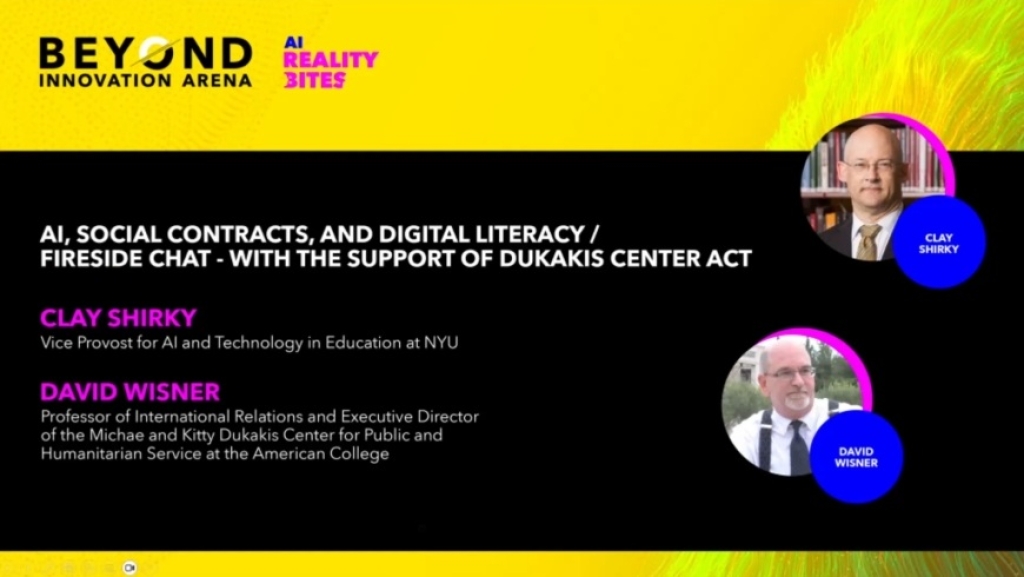
The Michael and Kitty Dukakis Center for Public and Humanitarian Service organized a session at this year’s Beyond technology forum and exhibition, which took place at the Metropolitan Expo Centre in Athens. David Wisner, Executive Director of the Dukakis Center, hosted a fireside chat on “AI, Social Contracts, and Digital Literacy” with Clay Shirky, author of Here Comes Everybody (2008) and Vice Provost for AI and Technology in Education at New York University. The Dukakis Center was acknowledged as a supporting institution at the Beyond forum.
Beyond was launched at TIF - Helexpo in 2021 by Helexpo board president Tasos Tzikas. According to the event organizers, “the exhibition serves as a hub for networking, knowledge sharing, and hands-on experience with pioneering innovations.” The 2024 iteration focused on artificial intelligence (AI) and was attended by a record number of participants and visitors. Beyond 2025 focused likewise on “confronting the practical and sometimes harsh realities of artificial intelligence as it integrates into various aspects of society.”
The Dukakis Center session, entitled “AI, social contracts, and digital literacy,” took place at a prime afternoon hour on the second day of the conference, Saturday, April 5, following a session featuring senior administrators from three Greek public universities.
The discussion with Clay Shirky focused on three lines of inquiry: the line leading from the development of the Internet in ca. 1992, the importance of which Professor Shirky described in his 2008 book Here Comes Everybody, to the appearance in 2022 of ChatGPT; Shirky’s role at NYU and the challenges he faces as lead edtech administrator for NYU’s global operation; and the broader social implications of the emergence and widespread application of AI technology.
Named a “Top 100 Global Thinker” by Foreign Policy in 2010, Clay Shirky has published six books and appears frequently in the mainstream media. At New York University since 2001, his current role includes designing, developing and enhancing all academic aspects of technology-based teaching and learning. Mr Shirky also has teaching affiliations at NYU with the Arthur L. Carter Center of Journalism and the Tisch School of the Arts. In 2014-2017, he served as Chief Information Officer at NYU Shanghai.
The Dukakis Center session was well attended, with some 100-120 people in the audience. One attendee, Luca Moreno, founder and CEO of the Italian AI firm Nextatlas, later wrote on social media, “this was one of the standout moments of the conference, such a great conversation with the brilliant Clay Shirky!”
On the eve of the opening ceremony of Beyond 2025, Dr. Wisner and Mr. Shirky were also invited by the conference organizers to interact with a select group of Beyond participants in a three-hour closed-door leadership dialogue on policy implications of the current AI vogue. The session was moderated by Jovan Ratkovic, sometime foreign policy advisor to Serbian President Boris Tadić. One of the key exchanges featured Vassilis Koutsoumpas, Digital Policy and AI Adviser to the Prime Minister of the Hellenic Republic, and Panagiotis Vlachos, Secretary for Public Sector at PASOK-KINAL and cofounder of “Vouliwatch,” who reviewed the policy priorities of leading Greek political parties. Discussion also focused on the policy and regulation apparatus of the EU and of individual EU member states, and political economy dimensions of approaches taken to regulation in the EU and in the US.
The organizers of this year’s Beyond estimate that over 15,000 people visited the exhibition and/or attended the forum between April 4 and 6. Untold numbers of visitors will have seen the Dukakis Center logo at select points in the expo center; ACT was the only academic institution listed among sponsors and supporting institutions. The exposure should clear the way for ACT to play a modest role throughout Greece in matters of information technology. Indeed, the policy ecosystem is still fluid enough for knowledgeable ACT stakeholders to be involved in meaningful ways.
Chief takeaways from the forum were as follows: the widespread adoption and development of AI is a significant turning point in terms of the impact of technology on society globally, but is still misunderstood. (As Clay Shirky quipped, “whatever works is no longer AI.”) Nonetheless, the mood was generally optimistic and distinctly non-partisan.
The Dukakis Center will follow up by taking the following actions: supporting IT faculty and staff strategically to attend such events and indeed, hosting guest speakers in areas which correspond in-house research strengths; networking with Greek and international colleagues exploring dimensions of AI most of interest to faculty in the humanities; reviving a discrete policy engagement within the Dukakis Center in the field of civic tech and civic AI; and, finally, arranging annual participation in and attendance at Beyond Thessaloniki going forth.
Incidentally, the Dukakis Center has organized events previously with two of the principal organizers of Beyond, now in its fifth year. Both Anastasios Tzikas, President of the Board of Helexpo, and Mihalis Stangos, Managing Director and CEO of MSCOMM, have spoken under the Dukakis Center banner, most recently in May 2020, when Mr, Tzikas appeared in the landmark Zoom webinar entitled “Φέτος το φεστιβάλ θα είναι διαφορετικό.” Dr. Wisner has appeared meanwhile at Helexpo, having presented Spyros Katsoulas’ book Διλήμματα στο Τρίγωνο in May 2023 at the Thessaloniki International Book Fair.


