
Dukakis Center and Demos Center co-host season finale at Vellidis Convention Center
Our fans were chuffed. Jaws dropped around the room. A lone, unnamed journalist who had stayed to the bitter end triumphantly called the scene before him an unqualified success -- "Με επιτυχία ολοκληρώθηκε!” he would write in his midnight lede.
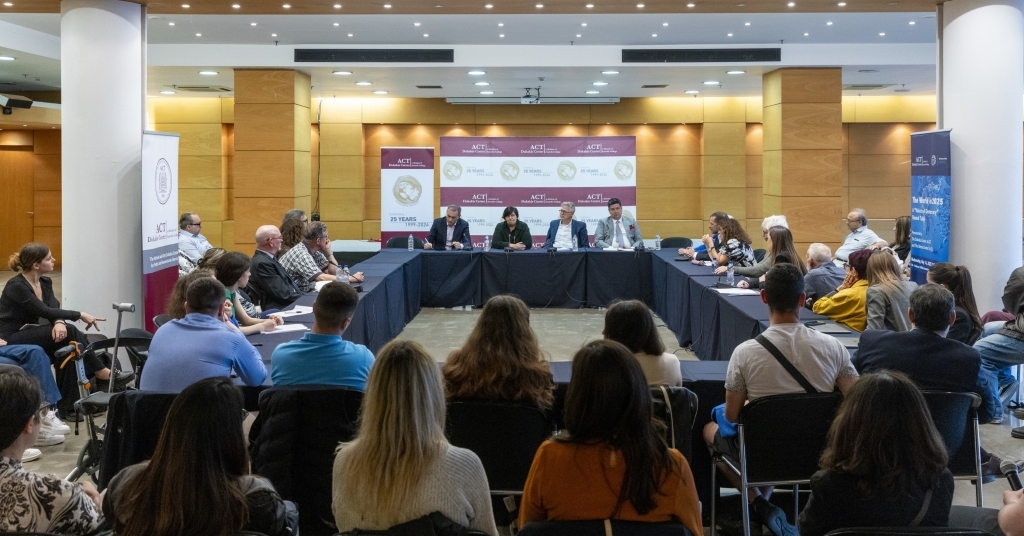
The Dukakis Center at ACT thus brought its Silver Jubilee celebrations to a rousing conclusion this past Wednesday evening, May 14, in a star-studded round table session on the state of world politics halfway into 2025.
A SRO audience at Olympias Hall in the Vellidis Convention Center was treated to a veritable masterclass in international relations in the twenty first century. Co-hosted by the Dukakis Center and the Demos Center at the American College of Greece, and c0-moderated by David WIsner, Professor of International Relations at ACT and Executive Director of the Dukakis Center, and Nektaria Stamouli of Kathimerini and Politico Europe, a veritable who’s who of international relations experts from throughout Greece provided the analysis for well over two hours, to an audience whose attention never waned.
From the off it was evident that the quality of the discourse would be uniformly high -- as was acknowledged after hours by the participants themselves. One by one the featured panelists opined and offered their interpretations on how best to understand events unfolding almost in real time. Constantinos Filis, Professor of International Relations at the American College of Greece and Director of the Institute of Global Affairs, opened the discussion, followed by Maria Gavouneli, Professor of Law at the University of Athens and Director of ELIAMEP, Peter Gries, Professor of Chinese Politics, and Lee Kai Hung Chair and founding Director, Manchester China Institute, and Spyros Litsas, Professor of International Relations Theory, University of Macedonia.
How should one understand the leadership style and policy preferences of the Trump administration? How should Europe and the EU respond? How is one to make sense of developments in Russia, China, the Middle East, and elsewhere? What kind of world order is emerging -- bipolar, multipolar, multi-centric, to use Professor Filis’ term? Is the post-1945 liberal international order in its final death throes? A few themes were underscored repeatedly: trust in American leadership had been lost; Donald Trump’s motives and guiding principles are still open to interpretation; a recalibration, if not realigning, of the international order was of the essence.
Not to be outdone, several members of the audience chimed in, asking probing questions of the panelists on such topics as different scenarios facing the EU and NATO, the ideological preferences of the American electorate, the specter of Greek-Russian relations, and the potential impact of AI and technological innovation in global politics. No one had the last word, fittingly, perhaps, given the contentious nature of the subject at hand and the multiform scholarly orientation of the panelists, who approached the topic from the perspectives of international diplomacy, international law, political psychology, and international relations theory,
Dr. Wisner left it to those present to attend the second “Voices of Democracy” round table on the same subject, to take place under the combined aegis of the Demos Center and the Dukakis Center in Athens on Wednesday, May 28.
On the eve of this encore appearance, it is worthwhile to recap what has been an extraordinary eighteen-month celebration, which began in late 2023 with a landmark poll and conference on the youth vote in the 2023 Greek parliamentary elections. In March and again in September of the following year Dukakis Center contributed to registering a record number of overseas Americans to vote, and then braved gale force winds and torrential rain to celebrate the year of global elections that was 2024. (Dukakis Center Director Wisner delivered a prescient presentation at Aristotle University Law School on the state of American media and democracy, and appeared occasionally on local television to assess the state of American politics.)
Throughout the 2024-25 school year the Center hosted and underwrote public events for the benefit of ACT and public university students on and off campus, including the annual Kavala Summer School in August 2024, the Thrace Negotiation Tournament in March 2025, and, remotely, the annual Civic Learning Week, also in March. James Quirk and Sarah Snyder visited Thessaloniki from ACT’s study abroad partner American University, and Dr. Wisner hosted a fireside chat with Clay Shirky, Vice Provost for AI and Technology in Education at New York University at Beyond 2025 in Athens -- one fan later wrote on social media that the Dukakis Center session “was one of the standout moments of the conference.” A pair of senior interns paid tribute, finally, to former Anatolia College President Bill McGrew and to the late Kitty Dukakis.
Planning is already underway for the 2025-26 academic year. The Center’s next major initiative will be a citizen-centric celebration ahead of the semiquincentennial of the signing of the Declaration of Independence, which actually launched during the Spring I 2025 semester. The project will entail recruiting teams of two or three study abroad students apiece to interact with inhabitants of Thessaloniki, to understand what they think about this important moment in American history. The Center will also host an event comparing the Greek Revolution of 1821 with the American Revolution of 1776.
The Dukakis Center will also hope to participate at next year's Beyond, and to host a small conference in Thessaloniki on Civic AI during the fall semester. A final year-long project will examine how American expats in Greece might fill the gap should the US Consulate General in Thessaloniki be downsized or even shuttered.


